
WHY ARE VITAMIN D DEFICIENCIES SO COMMON?
You can eat reasonably well, skip the tanning bed, and still come up short on vitamin D. That gap is now common enough to feel ordinary. In a national Australian sample, about 1 in 5 adults met a deficiency cutoff, and more than 2 in 5 more were insufficient. In Japan, insufficiency or deficiency reached nearly half of healthy adults in summer and more than 4 in 5 in winter. The surprise is not that levels fall. It is how quietly modern life removes the inputs that used to keep them up.
We left the sun behind
For most people, skin exposed to ultraviolet B is still the main vitamin D source. That waveband is a small slice of sunlight, and it changes with latitude, season, time of day, cloud, clothing, and melanin. Above about 40 degrees, some months simply do not supply enough UVB for reliable synthesis, whatever your intentions. Closer to the equator, a few unprotected minutes near noon may be enough for lighter skin, while darker skin may need longer for the same effect. Indoor work closes that window. Office life, commuting, and low activity show up again and again alongside lower status. Urban adults can log only about 10 to 15 minutes of measured UV exposure a day. Indoor workers also describe a stack of barriers: no time at midday, a preference for fair skin, safety worries, cultural clothing practices, and workplaces with no outdoor break. Older adults are hit twice. Skin synthesis declines with age, and habitual exposure of arms and legs is often missing; in one geriatric sample, low vitamin D persisted in every season. Sunscreen is a smaller villain than the slogan suggests. Properly used sunscreen can reduce UVB, but everyday amounts often do not wipe out production, and a high-UV holiday study still found vitamin D rose when sunscreen prevented sunburn. Total sun avoidance is the larger problem. Public skin-cancer advice should stay; the missing piece is a plan for vitamin D that does not depend on burning.
Food was never the backup plan
A typical Western diet does not replace the sun. Few foods are naturally rich in vitamin D. The richest natural sources include fatty fish such as salmon, mackerel, sardines, and tuna, along with cod liver oil. Other helpful options are egg yolks, beef liver, and mushrooms that have been exposed to ultraviolet light. Fortified foods like milk, orange juice, cereals, and yogurt can add modest amounts, but only if people actually eat them regularly, and the rise in blood levels is often small.
Body composition matters too. Vitamin D is fat-soluble and can be sequestered in adipose tissue, so a large fat mass can coexist with a low blood level. Obesity is an independent predictor of deficiency in population data. Mouse work also suggests high-fat feeding can lower hepatic conversion of vitamin D to 25-hydroxyvitamin D (mechanistic proxy from an animal model). Low activity may compound this; whether exercise can mobilize stored vitamin D is still a hypothesis to evaluate.
"Normal" on the lab report can still be low
Here is the trap. Many laboratories and bone-focused guidelines call deficiency only when 25-hydroxyvitamin D is below about 20 ng/mL (50 nmol/L), and they treat roughly 20–30 ng/mL as a gray zone. A result of 28 ng/mL can print without a red flag. That cutoff was built mainly around severe bone disease, not around every extra-skeletal question people now ask.
Guidelines do not agree on the next step. A European expert consensus often aims for about 30–50 ng/mL. Some reviews argue that levels above 30 ng/mL, and in some analyses about 40–60 or 40–70 ng/mL, track with lower disease risk in observational data. Other authorities still treat levels above about 50 ng/mL as a zone where benefit is uncertain and harm has not been excluded. Assay methods also differ, so the same blood can look different across labs.
A functional target of 50.00–90.00 ng/mL sits at the high end of this debate. It is a clinical goal some practitioners use when they want more than the minimum that prevents rickets or osteomalacia. It is not what most standard panels are designed to flag, and it is not a license to push the number as high as possible. In chronic kidney disease, one trial saw hormonal changes mainly once levels reached about 51 ng/mL, without clear safety signals up to a group mean near 92 ng/mL (extrapolated from CKD, not a healthy-adult dosing study). For everyone else, the practical point is simpler: a lab that stays silent until you are very low will miss a long stretch of insufficiency.
How to close the gap without guessing
Start with a 25-hydroxyvitamin D test if you are indoors most of the year, have darker skin at high latitude, live with obesity, are older, avoid animal foods, or have a malabsorption condition. Universal screening is not required; targeted testing is the more defensible approach.
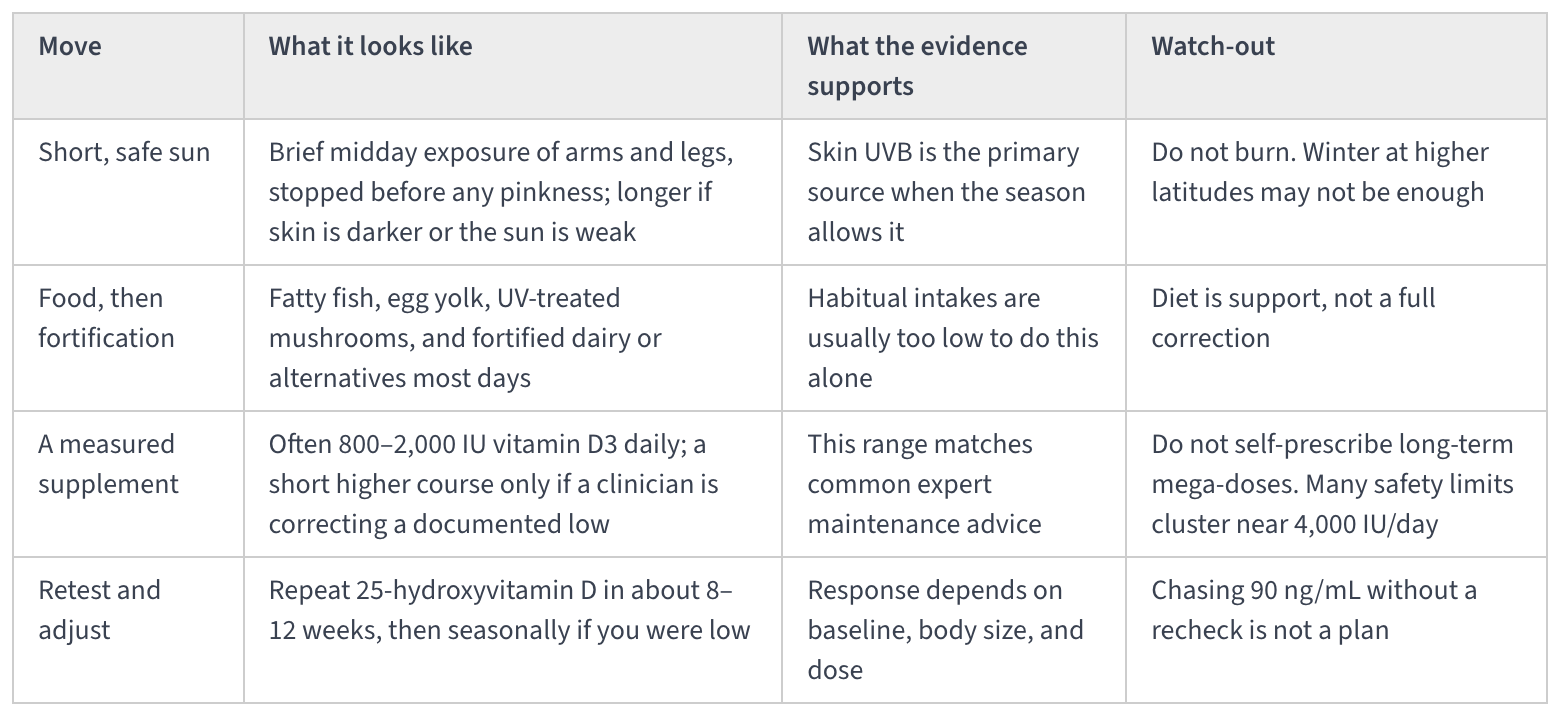
A reference table on care plan moves.
If you have obesity, liver disease, or fat malabsorption, a standard capsule may correct you slowly. That is a reason to involve a clinician, not to double the bottle. Vitamin D is most clearly useful when levels are low. It is not a cure-all for every modern symptom.
The fix is unglamorous: know the number, respect the season and your skin, eat the foods that help, and supplement to a target you and your clinician can defend. A report that says “normal” at 25 ng/mL has not answered whether you are in the 50–90 ng/mL range some clinicians prefer. Ask for the value, not just the flag.
References
Malacova, Cheang, al.. Prevalence and predictors of vitamin D deficiency in a nationally representative sample of adults participating in the 2011-2013 Australian Health Survey. 2019.
Asakura, Etoh, al.. Vitamin D Status in Japanese Adults: Relationship of Serum 25-Hydroxyvitamin D with Simultaneously Measured Dietary Vitamin D Intake and Ultraviolet Ray Exposure. 2020.
Neville, Palmieri, Young. Physical Determinants of Vitamin D Photosynthesis: A Review. 2020.
Kift, Webb. Globally Estimated UVB Exposure Times Required to Maintain Sufficiency in Vitamin D Levels. 2024.
Shahudin, Sameeha, al.. Barriers towards Sun Exposure and Strategies to Overcome These Barriers in Female Indoor Workers with Insufficient Vitamin D: A Qualitative Approach. 2020.
Nowak, Hudzik, al.. Lack of Seasonal Variations in Vitamin D Concentrations among Hospitalized Elderly Patients. 2021.
Rolizola, Freiria, al.. Vitamin D insufficiency and factors associated: a study with older adults people from primary health care network. 2022.
Young, Narbutt, al.. Optimal sunscreen use, during a sun holiday with a very high ultraviolet index, allows vitamin D synthesis without sunburn. 2019.
Raymond-Lezman, Riskin. Benefits and Risks of Sun Exposure to Maintain Adequate Vitamin D Levels. 2023.
Dunlop, Boorman, al.. Evidence of low vitamin D intakes in the Australian population points to a need for data‐driven nutrition policy for improving population vitamin D status. 2022.
Nikooyeh, Neyestani. The effects of vitamin D-fortified foods on circulating 25(OH)D concentrations in adults: a systematic review and meta-analysis. 2021.
Hengist, Perkin, al.. Mobilising vitamin D from adipose tissue: The potential impact of exercise. 2019.
Roizen, Long, al.. Obesity Decreases Hepatic 25‐Hydroxylase Activity Causing Low Serum 25‐Hydroxyvitamin D. 2019.
Amrein, Scherkl, al.. Vitamin D deficiency 2.0: an update on the current status worldwide. 2020.
Ramasamy. Vitamin D Metabolism and Guidelines for Vitamin D Supplementation. 2020.
Płudowski, Takács, al.. Clinical Practice in the Prevention, Diagnosis and Treatment of Vitamin D Deficiency: A Central and Eastern European Expert Consensus Statement. 2022.
Sîrbe, Rednic, al.. An Update on the Effects of Vitamin D on the Immune System and Autoimmune Diseases. 2022.
Grant, Wimalawansa, al.. Vitamin D: Evidence-Based Health Benefits and Recommendations for Population Guidelines. 2025.
McKenna, Flynn. Preventing Type 2 Diabetes With Vitamin D: Therapy Versus Supplementation. 2023.
Sempos, Binkley. 25-Hydroxyvitamin D assay standardisation and vitamin D guidelines paralysis. 2020.
Strugnell, Sprague, al.. Rationale for Raising Current Clinical Practice Guideline Target for Serum 25-Hydroxyvitamin D in Chronic Kidney Disease. 2019.
Jódar, Campusano, al.. Calcifediol: a review of its pharmacological characteristics and clinical use in correcting vitamin D deficiency. 2023.